Showing posts with label Pilot Season. Show all posts

Saturday, February 26, 2022

The Endgame – “Pilot” (2022)

The first episode of ‘The Endgame’ aired February 21, 2022, at 10:00pm Eastern on the NBC network.  It was developed by Jake Coburn and Nicholas Wootton, who also wrote the pilot, and was directed by Justin Lin.  It starred Morena Baccarin as Elena Fedorova and Ryan Michelle Bathe as Val Fitzgerald.  Its overnight ratings were around 3.3 million viewers with a .46 share in the 18-49 demographic.  It ranked fourth overall for broadcast television for the night.  It was a production of Universal Television LLC, a direct subsidiary of NBCUniversal, as well as My So-Called Company productions, know for ‘The Vampire Diaries’ and ‘Roswell,’ and Perfect Storm Entertainment, which is associated with Justin Lin.

Not gonna criticize a temp title for the pilot.

              The involvement of Julie Piec and Justin Lin as executive producers is interesting, but this entire show is the brainchild of Coburn and Wootton.  They both have pretty extensive television backgrounds.  Coburn seems to have gotten his start as a writer on the Lonelygirl15 quasi-hoax back in 2007 which he managed to convert into gigs on various CW shows such as ‘Gossip Girl’ and ‘Arrow,’ mostly as a writer/producer.  Wootton goes all the way back to the mid-90’s, starting on ‘Brooklyn South’ before creating the one-season ‘City of Angels’ in 2000 and also working as a writer/producer on the later seasons of ‘NYPD Blue’ and ‘Law & Order,’ as well as more recently ‘Scorpion’ and ‘Stumptown.’ 

              Morena Baccarin has been kicking around television and movies for some time now.  Her big break came as Inara Serra on ‘Firefly’ and after that she popped up as the lead villain in the ‘V’ remake, appeared in several seasons of ‘Gotham,’ and I personally liked her recurring role in ‘The Mentalist.’  Ryan Michelle Bathe’s first big role was a recurring one in ‘Boston Legal’ and also appeared in ‘Army Wives,’ ‘This is Us,’ and ‘The First Wives Club.’ 

              Justin Lin directing this seems surprising at first, considering he’s mostly known for helping to turn “The Fast and the Furious” movies into the franchise it is today, helming movies three through six and returning for the ninth to start to wrap up the series, but he’s also directed pilots for shows such as ‘S.W.A.T.’ and ‘Scorpion’ as well as episodes of ‘True Detective’ and the ‘Magnum P.I.’ remake.

              All of which is a long way of saying that given the people involved this pilot should have been much, much better than it was.  To paraphrase myself, a tv pilot has roughly three things to accomplish during its run time: establish the premise, demonstrate how it’s going to function on an episode-to-episode basis, and make you care about the characters.  When I first started looking at pilots, I thought the first two were the most important goals, but the more episodes I saw the more emphasis I placed on the third.  Good characters can make up for a lot.  In this case it really doesn’t matter as this is an example of a nearly complete triple-failure.

Let’s lay it out in order and start with the premise: an international fugitive who runs a worldwide criminal empire including running a mercenary army and money laundering is captured by the US government, but it turns out it’s all part of her nefarious plan when her people take over seven banks in New York City in order to collect blackmail material on the Attorney General and the head of Homeland Security and makes it clear her schemes are just beginning.  And by the end that’s really it: there’s this criminal in ostensible US custody who has a mysterious ongoing plan involving holding banks hostage.  This is the setup for a Michael Mann movie, not the start of a supposed multi-season television show.

97% of her characterization right here.
              This leads directly into the second problem, because I have no idea how this show is going to function from week to week.  By the end of the episode, it becomes clear that the status quo for the season is going to be that Elena is in custody, the banks are still taken over by her mercenaries, and that nothing is going to be resolved any time soon.  It very much feels like the first half of a two-part pilot episode where in the second half we get the actual setup for the show but no, this seems to be it.  The synopsis of the yet-to-air second episode reads “A kidnapping orchestrated by Elena puts Val to the test as her past resurfaces and becomes a part of the bigger play.  The FBI Task Force contends with an unexpected turn of events in one of the banks.”  To the best of my knowledge this is going to be a series of episodes detailing the ongoing hostage situation as these seven banks are simply held hostage and Elena sits smugly in custody.  I’m sure other elements are going to be introduced but we have no hints in the pilot what they will be.  Nothing indicates this is a limited series, and I’ve looked.  I’ve written before about Season 3 problems, the notion that a premise will burn out before a show hits its third season, and I’m not entirely sure how this could make it to even thirteen episodes.  The show can really only go one of two ways: it either manages to be whip-smart and serve us bite-sized versions of the movie “Heat” for forty-two minutes every week with enough variations that it doesn’t get stale, or it focuses on other crimes outside of the banks and hopes we don’t notice that those hostages must be getting pretty hungry by now.

Which brings us to the third goal of a pilot and the biggest problem with this show, which is that the characters aren’t so much people as they’re small bags filled with crumpled scraps of papers with tropes written on them.  There are only two actual characters in this series surrounded by plot devices and exposition dumping machines, which is acceptable for a pilot, generally the supporting cast gets fleshed out as the series progresses, the problem is that both of the main characters suck.  Elena herself is yet another stupid person’s idea of a smart person.  She’s this criminal mastermind genius that’s managed to rise to the top of the world of crime and in the language of this show being smart involves magical predictive powers.  It’s one thing to be prepared and have some plans in place, quite another to be capable of what this show portrays.  To break down the first example the show gives of her abilities: sometime before the start of the episode she has one of her people deep enough inside the FBI that he’s personal security to the Attorney General of the United States.  He plants an envelope on said AG which says, “I’m the Queen.”  After she’s been delivered to her holding area she’s given a pen and a piece of paper to write down some information.  At the same time her people take the first bank hostage, then one of them holds up a message to a camera reading “Director Real: Bow to the Queen.”  As the director of the FBI is getting a phone call about this Elena hands the piece of paper to the AG, on which she’s written “check your coat pocket.”   He finds the envelope but doesn’t open it until the FBI director comes over and asks her if she sent the message and who the queen is, at which point the AG opens the envelope and reads it.

I don’t really feel the need to point out all of the ways that this is stupid.  It’s impressive if you don’t think about it for more than a few seconds, which the show is really hoping you don’t.  Enough things beyond Elena’s direct control had to happen in exactly the right order with exactly the right timing for that moment to land and while the moment itself is decent enough as dramatic beat before a commercial break in the end it doesn’t have any real effect on the plot.  In fact, it ends up as a net-negative for Elena as her deeply embedded agent in the FBI is quickly identified and taken into custody.  The fact that the agent had Eastern-European style gang tattoos all over his arms yet somehow was personal security to the US AG is in its own category of stupid.

Becuase of all the planning, y'see,

Her characterization just continues on like that.  Characters will make several sets of decisions and actions and end up at a place and time where magically Elena predicted they would be presumably weeks before.  Things keep happening that she apparently planned for with such magical timing and foresight that it’s never impressive, it’s just implausible and annoying and robs every scene of tension, and eventually it occurs to the audience that while she’s a main character Elena never actually does anything over the course of the episode.  She stays in one room saying various mysterious things hinting at bigger plans and smiling smugly.  Everything she’s done that’s supposedly amazing happened offscreen before the episode even started.  Because of her magical planning powers she’s never in danger, never threatened, never thrown off.  She has just one note to play.  The meandering accent that Morena Baccarin strains her mediocre lines through doesn’t do her any favors.

The character Elena is facing off against doesn’t fare any better.  Her antagonist is a mid-ranking FBI agent with whom she has a sketched-in history, involving some vague happenings in Gambia as well as both their husbands in what’s hinted at being the real ongoing mystery that’s going to be running in the background of all the bank shenanigans.  Val Fitzgerald is, as a supporting character helpfully states, the “first Black supervisor in the criminal branch of the New York office” of the FBI.  She’s so honest she got her husband thrown in prison for taking drug money, although she still loves him.  This causes her problems within the FBI as they suspect she’s dirty too, which establishes one of her two entire traits (one more than Elena, to be fair), which is to be angry all the time.  She drives angry, she talks angry, she invades personal spaces and doesn’t take guff from anyone.  She’s in a room with the Attorney General of the United States, the Director of the FBI, and the Director of Homeland Security and she’s the one telling them they’re wrong and what they need to do while verbally banging her fist on the table. 

The other note she gets to play is basically magical realization powers.  She figures out Elena is involved in taking the banks hostages through leaps of logic that are only impressive because the writers decided she’s right.  I counted six distinct moments in the forty-two minutes of the pilot where Val pauses in mid-sentence, the camera pushes in on her face, and she Figures Something Out.  If we’re lucky we’ll get a thrown-away line of dialogue to kind of explain how she came to her realization but mostly she just spits out the next plot point and we’re off.  From what I can work out this is essentially to balance out Elena’s magical planning powers.  This also allows her to angrily insist she was right to her previous doubters and be angry again when they insist on not taking her advice the next time.

She was right.

What this turns into in the finished product is Elena being smug about something, Val figuring out what she’s smug about, but just slightly too late so Elena’s plan still works, then Elena hints she’s smug about something again, and repeat until the episode is over.  They ping pong back and forth and nothing Val does interferes with Elena’s plans, and in fact her presence is factored into those plans in such a way that if she stopped to think about it she’d figure out that in a way she’s actually helping her.  They’re basically operating in a closed system that was apparently all mapped out before the season started so there’s a distinct feeling that nothing they’re doing matters. 

So using my usual rubric those are the ways this fails as a pilot, but it also fails pretty badly as a basic piece of filmed entertainment.  Before we get into specifics and the inevitable comparisons to ‘The Blacklist’ we need to examine its use of linear time as a storytelling device.  This isn’t anything special to ‘The Endgame,’ nor is it something I think the makers intentionally exploited, but it’s something I noticed from the manner in which I watched this episode.  The first time through I watched it while I took notes, which involved frequently pausing it while I typed out my thoughts, noting all the inconsistencies and leaps of logic.  The second time through I just let it play and while all the same problems were there without the ability to sit and consider and work out the implications of events the whole thing flowed a bit better because there wasn’t enough time to think.

To give a single example: there’s a throwaway line from Val relatively early on that they need to order protection to all of New York City’s banks.  Her boss, already established as an asshole antagonist, mocks her by stating that putting a “91 prevent defense” around all 765 banks in the city would be madness.  Several scenes later, after a bomb has gone off in response to a SWAT team trying to infiltrate a bank currently held hostage, he decides to call for exactly that, despite the fact that several other banks had previously also been taken over and the detonation of some bombs doesn’t actually change the situation or in any way make it more likely that other banks are also in danger.  But in a nifty narrative example of The Kuleshov Effect because the idea was planted earlier and something dramatic has just happened, we buy into the idea that this is an appropriate response.  It also reinforces our respect for the protagonist since it was her idea and (clumsily) sets up a plot point for later.  If we were given time to think about this, like I was when taking notes, this would instantly ring false but because we’re on to the next scene and dealing with new information it’s just enough to fade into background events.  This is the pattern throughout, and presumably why Justin Lin was brought in.  A key skill in enjoying ‘The Fast and the Furious’ movies is to not care in the least how dumb they are.

Boo!
              That’s why whole sections of my notes railing against the nonsense plot and implausibility of events weren’t exactly wasted but don’t matter that much in the end.  This show moves fast enough and throws enough at you that on a moment-to-moment basis that it hangs together just enough so that it doesn’t fall completely apart.  Nonsense plots aren’t enough in and of themselves to make something bad as long as the action is fun and the characters are engaging.  When those things also fail logic gaps are just another thing to add to the list of disappointments.

What’s presented in the opening of the show as a framing device nicely demonstrates the fundamental problem the episode has which is, in essence, that absolutely nothing gets resolved by the time it’s over.  Text appears on the screen establishing that we’re in Belarus, ‘six months after the collapse of the Soviet Union.’  What’s interesting here is that it doesn’t give a date.  I’ve done the math and the ages do work out but there’s no reason given in the episode itself that it can’t just say something like ‘May 1992.’  If you’re feeling generous the writers are planting seeds about the geo-political fallout of the collapse of the USSR which will matter to the plot later on but if so that doesn’t pay off in this episode and as is demonstrated throughout the writers have a fairly low opinion of the intelligence of their audience, so I think this is just an effort to not confuse people with specifics.

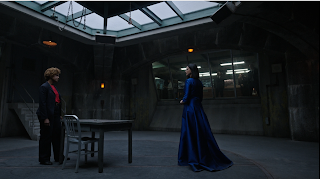
              Over the text we have Elena saying in a voiceover (later this is revealed to be a story being told to Val) that she has a little story to tell us, a fairytale.  It’s about a daughter who loved her dad, who brought her up in a harsh world and taught her how to fight to survive.  We’re shown a father and a daughter overlooking a road.  An SUV comes along, and the daughter is given a rocket launcher she shoots at the car, causing it to crash.  Interspersed throughout the rest of the episode we see scenes of the father and daughter approaching the car then following the trail of a survivor to a little wounded girl in the woods, who the daughter stabs.  The stabbed girl is then revealed to be a young Elena, and the voiceover starts again except this time it follows Elena in the car which gets shot by the rocket and then shows her being attacked in the woods.  She fights back and kills the father and daughter.  The episode ends with Elena saying she has another story to tell Val.

              The problems start with how the story is presented.  All of the stuff with the original father and daughter, their lines of dialogue, them approaching the car and following the trail, all of that was made up, Elena didn’t see any of it, so it doesn’t matter.  It’s presented to the audience as a clever twist: you think the voiceover is talking about this little girl but actually it’s this other little girl, fooled you.  But remember this is a story being told to another character, and when we cut back to Elena and Val when the little girl is stabbed Val is reacting as if the story she was told is the one we were shown, which doesn’t make any sense.  Having the visuals diverge from the voiceover works just fine, it’s a very common storytelling technique in film, but it doesn’t work when it’s one person telling another person a story.  It basically means that Elena told most of a story, stopped, then said “Oh, I was lying, let me start over.”  Making it be an actual story told in the actual episode just underlines how artificial the entire conceit is.  The story is: the car I was riding in got blown up, I ran into the woods, got stabbed but fought back and I lived.  That’s a pretty traumatic event for a little girl and it’s fine as a backstory, but it’s not enough to be the dramatic reveal for an entire episode of television.  She also finishes the story while Val isn’t in the scene, which the show is just hoping you don’t notice.  In fitting with the rest of the episode it’s left completely unresolved by the time we hit the credits.

              It’s also described to us as a fairytale, which it is not.  Considering that Elena’s criminal codename is Snow White and that the FBI director drops the line, “Snow White and the seven banks,” along with episode two of the show being titled ‘Fairytale Wedding,’ it’s hard not to come the conclusion that the writers have a burning desire to seem very clever without the ability to actually be clever.  I have a very firm suspicion that if this show miraculously makes it to the end of the season it’s going to end on a cliffhanger with no answers supplied to the audience because I don’t believe the writers actually have any.

About as satisfying an ending as the show has.

              So let’s address ‘The Blacklist’ in the room.  That show is currently in its ninth season and has just been renewed for a tenth so however you feel about its quality (general consensus is that its best days are well behind it) the engine it’s built on is still working just fine.  In addition to watching this pilot twice I also watched the pilot to ‘The Blacklist’ and this entire thing could have just been a list of ways that show did it better. 

              Let’s run down my pilot requirements again.  The premise starts off the same: an international fugitive is in US custody but has a master plan.  In this instance, however, we’re given specifics: he has a list of international fugitives he intends to bring down and is willing to help the government do it.  He very openly has his own agenda but the government is willing to put up with it if it helps them catch these criminals.

              This leads directly to how the shows will functions from week to week, which is basically as a procedural with a twist.  This is demonstrated in the pilot: the FBI is given the name and background of a bad guy and with the mastermind’s assistance they kill him and foil his plan.  The authorities spar with the criminal, there’s tension over his methods, but at the end of the episode the bad guy is dealt with, and the overarching plot moves forward.  Repeat as needed and you’ve got yourself a show.

Again we have basically only two characters, the criminal mastermind and the FBI agent counterpart.  However this mastermind turned himself in, volunteers information on another criminal, actively takes part in both tracking down the criminal and foiling his plan, then announces he’s willing to work with the authorities to capture other criminals.  So rather than just being in one room saying vague things he’s shown taking actions, figuring things out, is in more than one location, and at one point has a pen stabbed in his neck so he’s shown to be fallible.  The show also frankly cheats by having him played by James Spader, as with all due respect to Ms. Baccarin she’s no James Spader.

The FBI counterpart is the exact opposite of Val Fitzgerald.  Instead of already being a fairly senior FBI agent who has a history with the mastermind she’s a new recruit who has no idea who he is.  This allows her to be an audience stand in for exposition dumps and we identify with her when she feels overwhelmed and feel good for her when she triumphs.  She’s also allowed to have more than one emotion: she’s alternately excited, scared, sad, angry, relieved, annoyed, she gets to react to what happens to her with human emotions.  The episode also ends with a mystery involving her husband, so I can’t stress enough how much ‘The Endgame’ just rips off ‘The Blacklist’ wholesale.

A titanic struggle of wills.

‘The Endgame’ did not get good reviews.  It’s currently sitting at a 44 on Metacritic.  Its ratings were all right but it followed a reality show premiere and I will be shocked if they keep even two-thirds of their premiere audience for the second episode.  As if everything listed above wasn’t enough there’s a whole boatload of things I didn’t manage to work into the above paragraphs: the AG of the US, the Director of the FBI, and the Director of Homeland Security not only all being in the same undisclosed location at the same time but also being portrayed as tough guy veteran agents when in reality they’re political appointees, the fact that after accomplishing literally nothing our hero bursts into the holding area to confront Elena and says “The worst day of my life and I still almost got you.  What do you think I’ll do tomorrow?” when Elena has no idea what Val supposedly just did, the dramatic reveal at the end that Elena’s supposedly dead husband is actually still alive in an American prison as if we’re supposed to care, I could keep going for a very long time.  This failed as a pilot and as a simple episode of television.  When I’ve previously reviewed pilots I’ve had the foresight to know how they ended up doing and while I suppose there’s always the chance that history will prove me wrong as the network television landscape isn’t what it was even ten years ago I will be absolutely shocked if this show manages to make it all the way to thirteen episodes.  I had this vague idea that the Golden Age of Television had this whole tv thing figured out but this just goes to show you what gets on the air is just as random as ever.

Thursday, October 29, 2020


Pilot Season – She-Wolf of London

    While having an admittedly great title (possibly stolen from a 1946 film) this show has to have one of the most tortuous production histories I’ve ever seen. This show was a product of the Hollywood Premiere Network (HPN) which was formed in 1989, itself rising from the ashes of the Premier Program Service (PPS), an attempt by Paramount Domestic Television (‘War of the Worlds’) and MCA TV (the record label, which through various acquisitions had bought both a half-interest in the USA Network, the other half belonging to Paramount, and also purchased WWOR-TV in New York City, one of the largest independent tv stations in the country) to cobble together it s own “fourth network” in competition with the then-struggling Fox network. After the demise of PPS HPN was formed by partnering WWOR-TV with KCOP-TV in Los Angeles to form a kind of bifurcated national platform. It shopped around to other independent stations a two-night package (including ‘Star Trek: The Next Generation’ as part of the package, remember Paramount owned Star Trek) consisting of ‘Shades of L.A.,’ a supernatural neo-noir starring a detective who could communicate with ghosts, ‘They Came from Outer Space,’ a sci-fi comedy featuring twin aliens from the planet Crouton which was created by Tom McLoughlin who also created the third show ‘She-Wolf of London,’ a US/UK co-production. All three series would be canceled within a year and the network disbanded.

The opening credits make the ones for Sylvester McCoy's Doctor look sensible.

    The production troubles don’t end there for ‘She-Wolf of London.’ The UK half of the production was done by Harlech Television (HTV) which was licensed to service the West Country and Wales region of the UK. Among the original board of directors was Richard Burton and Elizabeth Taylor (this has nothing to do with the show, it’s just interesting). They were best known for their work producing children’s television and were the first British broadcaster to air ‘Sesame Street’ (again just interesting). After the first fourteen episodes were shot in England HTV pulled its funding from the show and it relocated to LA, cutting both the budget and the cast and drastically retooling the show. Now re-branded as ‘Love & Curses’ only six LA episodes were produced before the show ended entirely.

    Shooting a television show in England under the auspices of a foreign production company while being based out of Los Angeles apparently caused its own set of problems. As the FCC isn’t a thing in the UK several episodes contained nudity which needed to be edited out of the US broadcast versions. About the only in-depth look at the series I’ve been able to find is the video essay by YouTube critic Allison Pregler and according to her research miscommunication was a frequent problem.

    So let’s finally get to the pilot itself. Creators of the show were Mick Garris and Tom McLoughlin, frequent mainstays in the lower echelons of horror film and tv. The only relatively known cast member was Kate Hodge who had previously starred in ‘Leatherface: The Texas Chainsaw Massacre III’ and would go on to find steady television work. No one else involved went on to anything of much note.

    The episode opens on an airplane with our hero Randi Wallace flying over to study under Professor Ian Matheson. After something of a labored meet-cute on the first day of class the two get to talking about his work. It’s at this point I need to mention the dialogue which is both belabored and so on-point as to be genuinely embarrassing. Like how the word ‘randy’ means ‘horny’ in British idiom? There’s a whole minute spent on that. They also spout genuinely nonsensical academic terms at each other about their research into the supernatural to fool the audience into thinking they’re smart. At no point do the characters in this show act like people.

    She mentions she’s having problems with her housing, he mentions his parents run a B&B, and just like that we have a sitcom premise. Over dinner with a set of British stereotypes she mentions she’s going “ghost hunting on the moors” which everyone who’s read the title for the show can translate as “will be attacked and turned into a werewolf.” The family natters on about possible future plot points and relatives while we’re all waiting for the werewolf attack. Later that night the professor gets what should come across as inappropriate as she’s getting ready for bed but the show treats it as no big deal, so sure.

    Cut directly to a tent presumably on the moors where Randi is typing on perhaps the bulkiest laptop I’ve ever seen, even for 1990. Cue werewolf POV cam and a severely edited attack on her tent. She wakes up in the hospital with a doctor and the professor standing over her, which is I’m sure how the NHS works. The editing goes nuts for several minutes as it cuts between hospital stuff and flashbacks to the same few seconds of werewolf attack and I can’t tell if it was originally shot this way or it was cobbled together back in the US from what footage they had. Eventually she ends up back at the B&B with more British nattering.

    One of the selling points of HPN was the reduced budget of their shows and the presumably lowered licensing cost to the independent stations and it’s here that the lack of resources start to show. The episode starts flinging itself from scene to scene without the most basic of establishing shots or connecting dialogue, the audience just has to try to keep up. She’s in a library, cut to Ian reading in his office, then she’s in a laboratory with test animals, cut to Ian, cut to her wolfing out, cut to Ian who is apparently the only person left on the entire campus and who hears her transforming and so wanders out to investigate. He find the cages holding the test animals torn apart and is suddenly frightened by an awkward insert shot of a werewolf head. He gets chased to the library where we get a couple of shots of the werewolf costume in all its un-glory (and random slo-mo shots, I’m starting to feel bad for whoever had to edit this nonsense).

    Eventually the werewolf corners him in a closet and then just ... goes away for no discernible reason. Suddenly it’s the next day and Ian is talking with the police among the destroyed cages about Randi’s disappearance. They suspect her of some crime, it’s unclear of what kind or why and then the scene is over. Randi wakes up while taking a shower in a men’s locker room, which is at least interesting, and then we cut to the police leaving Ian’s office after having questioned her, which thanks show, glad that aborted subplot went nowhere and will never come up again. Also glad she’s still naked from the shower and wrapped in a blanket, that seems right. She instantly tells Ian she was the werewolf, which he doesn’t believe. She asks for his help in figuring out what happened which he instantly agrees to.

    This episode is increasingly spinning into incoherence. Cut to B&B, she’s reading. Cut to hypnosis session back in Ian’s office, she remembers the attack scene we’ve already witnessed. Cut to them both on the moors, climbing stuff. Now they’re picnicking, including two bottles of wine, where she was attacked. I think they’re flirting but it’s hard to tell. Now they’re chasing each other over rocks for some reason, and still flirting? She literally steps on a clue, a ring they instantly identify as having burst off someone’s finger and now they’re driving home and it’s all about the ring that was established mere seconds before. They come across a “traveling Gypsy carnival” because of course they do, they pull over for no established reason and Randi decides to talk to them. Ian objects even though he was the one driving and pulled over in the first place. Off-screen dialogue indicates that Randi’s “instinct’ is directing her to a fortune-telling Gypsy woman complete with crystal ball.

    She dismisses them until Randi shows her the ring which, again, she literally stepped on just minutes ago and is now claiming must have come from the werewolf that attacked her. She tells them to leave and they are instantly arguing several layers deep about werewolf mythology, how she was cursed, how to break the bloodline, I need to remind you that this caravan was introduced literally less than 90 seconds of screen-time ago. She senses another member of the caravan is the werewolf and now they’re in a car chase after him. After several jumbled shots of cars on dirt roads the werewolf they’re chasing pulls a literal Toonces moment and drives right off a cliff. The two of them teleport down the cliff where the werewolf is still alive, screaming in the wreckage of the car which then instantly catches fire and explodes. The caravan has disappeared, Ian believes her now, and with the most awkward ‘we ran out of footage’ cut I think I’ve ever seen they’re back at the B&B for more British nattering. They now have a makeshift dungeon in the basement of the B&B which, fine. There’s an awkwardly inserted shot of a newspaper ad for ‘occult researchers’ and then the show slaps us upside the head with the end credits.

I mean, sure.

    I am in something like awe of this episode of television. It plays like someone shot a bunch of footage in vague approximation of a written script then shipped it halfway around the world to be assembled by a completely different set of people into something as close to broadcastable as possible. From everything I’ve looked at this seems to have been at least possible given the production history. The thrown-together nature of the funding and distribution network behind this show somehow seems to have filtered down into the finished product. It’s the first tv show (and I’m including ‘Sleepwalkers’ in this) I’ve seen in some time to be so deeply confused at both a production and narrative level. 1990 was not a great year for television by any means but it did give us ‘Northern Exposure’ and ‘Law & Order’ so competence was at least possible. If you can track down episodes of this show its worth checking out for the bewildering set of circumstances that led to such a thing actually being produced. When I mentioned way back in my review of the pilot episode of ‘Friday the 13th: The Series' that “some truly weird shows were produced more or less outside of what we would now think of as the standard top-down managed model” I had no idea the rabbit hole went down quite this far.


Tuesday, October 27, 2020


Pilot Season – Werewolf

    What a strange and fascinating relic of the 80’s I’ve stumbled across. I was actually looking up facts on ‘She Wolf of London’ (stay tuned) when this got caught up in my searches. I can honestly say I’d never heard a single thing about this show before.

No, I'm not doing the "there wolf" joke.
I mean, yep, that's a title card all right.

    Back in 1987 the Fox broadcasting network was a fairly different beast than it is now. The rise and rise of Rupert Murdoch and the dread empire he built is far too big a subject to tackle for just this measly show but we can examine a slice for some background. First launched in 1986 The Fox Broadcasting Company was hardly the first attempt at a fourth broadcast network (after NBC, CBS, and ABC) but it was by far the most successful one. It was formed by the gradual takeover of 20th Century Fox film studio and eventual full ownership of a number of flagships stations reaching roughly 20% of the American market. They then cobbled together enough independent stations to be considered a nationwide network and officially launched in October of 1986.

    Almost everyone is familiar with their first two breakout shows, ‘Married ... with Children’ and ‘The Tracey Ullman Show.’ They gradually rolled out more shows over the following weeks, filling in the rest of their airtime with films and reruns of past shows they’d acquired the rights to. The new shows included such stalwarts as ‘Mr. President’ and ‘Duet’ (and, to be fair, ‘21 Jump Street,’ featuring a then-unknown Peter DeLuise of later ‘Stargate’ fame) as well as a Saturday lineup including ‘The New Adventures of Beans Baxter,’ ‘Karen’s Song,’ and debuting on July 11th, 1987, ‘Werewolf.’ The network struggled for its first three years of broadcast, becoming something of a joke, before the debut in 1990 of, yes, ‘The Simpsons.’ Thus began its slow march towards cultural dominance.

    ‘Werewolf’ is so of its time it’s fairly close to parody. After a terrible opening monologue by a character later introduced as bounty hunter Joe Rogan we cut to a club with the camera acting as a person’s POV. People nervously get out of their way as they make their way to the bar and order a drink, picking it up with an awkwardly angled hand so the camera can catch the raised symbol in scars on its palm. After a few moments the symbol starts to bleed.

    And the entire time the soundtrack is blaring Mike & the Mechanic’s “Silent Running.” If you’re not familiar with the song I’d take a listen, it’s actually really good, if entirely inappropriate for the opening of a werewolf drama.

    Soon enough a couple is attacked in the parking lot with any werewolves kept off screen. After a quick cut to presumably the next day we’re introduced to our main character, Eric Cord, soon to become our titular werewolf. After making out with his girlfriend poolside we’re treated to a sequence of his driving his soft-top convertible to the timeless classic “The Future’s So Bright I Gotta Wear Shades” by Timbuk 3, a song I will always associate with the show ‘Head of the Class.’ The soundtrack to this show, I swear.

    He gets home and finds his roommate hunched over a gun loading it with what turn out to be silver bullets. When confronted the roommate admits that the recent gruesome murders were done by him in his werewolf form. Our hero is disbelieving but agrees to tie up the roommate and wait until midnight to see what happens. While the roommate is tied up he explains the rules of how werewolves work despite never having been taught them himself, the key part of which is that if you can kill the head of the werewolf line it’ll get rid of the curse. Midnight comes, the roommate transforms, breaks the ropes tying him down, and Eric shoots him dead but not before being bitten.

    This pilot is an entire 82 minutes long and I need to stress to you how much padding it contains. Everything I’ve described above has taken us to the 34 minute mark. From the opening monologue (and don’t worry, we’re not done with that yet) to the poolside make-out session to the roommate telling in painstaking detail how he was attacked by a werewolf everything has an extra five or so minutes tacked on for no storytelling reason whatsoever, especially since none of these elements will be revisited after this pilot.

    Our hero is arrested, charged, and makes bail. This takes another nine minutes of screen time. He attempts to explain to his girlfriend what’s going on and eventually convinces her to lock him a storage locker. That’s another nine minutes. He’s missed his court date (I know it’s only been a couple of nights and court dates are set months in advance, just go with it) so a bounty hunter is set on his trail, the aforementioned Joe Rogan. Eric somehow ‘senses’ the werewolf who turned his roommate, confronts him at a marina, then runs away. Thirteen minutes this time. He gets his girlfriend to tie him up in a motel bathroom only to have the original werewolf show up and kidnap her. He falls and hits his head in the bathtub and some time later is awoken by the bounty hunter who found him somehow and takes him into custody. He wolves out, escapes, rescues his girl, and decides to go on the run, chasing the man who turned him into a werewolf. The end.

    It’s all very ‘Kung Fu’ / ‘The Incredible Hulk’ in that after the pilot the episodes’ plots were Eric making his way from place to place and helping out those he met along the way with his werewolf powers, all the while searching for the one-eyed werewolf (yes the bad guy has an eye-patch). This makes some amount of sense when you look at the talent behind the camera. The show was created by Frank Lupo, who also produced 70’s stalwarts such as ‘Battlestar Galactica,’ ‘The A-Team’ and ‘BJ and the Bear,’ the latter two of which shared a similar picaresque structure. Something else to note is that the episodes of the actual show were only half an hour long and even though it was canceled during its first season it still produced 28 more episodes. I’m not sure if they were going for a more soap-opera style structure or if they were just trying anything in those early days at Fox.  I can’t even tell you if the show is good or bad, it just is.

    The pilot ends as it opens, with Joe Rogan giving that monologue to presumably no one. It’s worth quoting in its entirety: “There are two kinds of people in this world: those who believe in flying saucers and those who don’t. When the world isn’t the same as our minds believe then we are in a nightmare. And nothing is worse than a nightmare except one you can’t wake up from.” Actually I tell a lie, that’s the truncated version from the end, there’s more at the beginning, most of it pointless filler, but I did forget the best line: “Growing up I remember reading the book ‘Alice in Wonderland.’ After Alice went down the rabbit hole a flower talked to her. She was surprised. You don’t need to be a psychiatrist to know if a flower ever spoke to a man that man would know terror.”

    And then BAM! “Can you hear me … can you hear me running?” God I love the 80’s. 

He was in Genesis, y'know.
"Can you hear me running, can you hear me calling you?"


Sunday, October 25, 2020


Pilot Season – War of the Worlds (1988)

    What an odd duck of a television show. There have been numerous adaptations of the source material over the years, the two most famous at the time this was produced being the infamous 1938 radio broadcast and the 1953 movie adaptation. Normally a first-run syndication show such as this would be a loose adaptation or sequel to the original book which would presumably be cheaper. Interestingly due to various copyright extensions the rights to the book had not yet entered the public domain. Instead this is in fact a direct sequel to the film version to the point where footage from the original is actually incorporated into the episodes themselves, an oddly ambitious move.

    The questions over rights issues begin to resolve themselves when you realize that the effort behind this series originated with that film’s producer George Pal and one of the involved production companies was Paramount Domestic Television, Paramount having made the 1953 film adaptation. This also presumably explains a scene in the second half of the pilot where the main characters enter a secret military warehouse and it’s framed and shot almost identically to the warehouse from ‘Raiders of the Lost Ark,’ another Paramount property.

    Paramount was also one of the studios behind the push for first-run syndication in the first place, being involved in shows we’ve already touched upon such as ‘Friday the 13th: The Series’ and ‘Star Trek: The Next Generation.’ They were clearly leveraging the intellectual properties they already owned into television series and ‘War of the Worlds’ would seem to be a natural fit. This is also the same era where they tried to launch their own affiliates network, UPN, which would fight a bitter war of attrition with Warner Brothers’ WB network, eventually resulting in the existence of The CW which we all know and love today and the absorption of all things Paramount into the hive-mind that is CBS.

I admit that's a pretty great show logo.

    On the whole this is not a badly put together show with one huge, glaring exception that runs right down the center like a crack in a window, which we will circle back around to. The basic premise, to steal a line from ‘The Royal Tenenbaums’ is: “Well, everyone knows that the aliens died at the end of ‘War of the Worlds.’ What this show presupposes is: maybe they didn’t?” Instead of dying the aliens went into suspended animation. The government, mistaking this for death, stored the alien bodies in steel drums and hid them away in military installations.

    The pilot opens with non-denominational terrorists (the kind the thieves in ‘Die Hard’ were just pretending to be) seizing control of a military compound in the middle of nowhere in order to gain access to a communications satellite they plan to use to broadcast their demands to the world. I’m not sure how much of this is actually nonsensical and how much of it is semi-realistic based on the telecommunications technology of the time. There are explosions and squibs and there is some budget here but it’s still television in 1988 and it rather painfully shows. I will say the editing in this sequence stood out as particularly choppy.

    After seizing control of the base the terrorists begin to make preparations for their broadcast. In all of the fighting some of the barrels were damaged and several aliens take the opportunity to emerge, although of course never on camera. It’s never really explained how this attack led directly to their escape, there’s some hand-waving about how the military was also storing nuclear material at the site which killed off the bacteria keeping the aliens in suspended animation but why they chose now to escape is never addressed, maybe the noise woke them. The terrorists being to be picked off by aliens who are always just off-screen and portrayed by three-fingered rubbery appendages that enter frame and drag the terrorists out of sight with far more strength than I recall them showing in the film.

    Intercut with all of this is various scenes at a college campus introducing us to our eventual protagonists, consisting of a quirky scientist studying deep-space transmissions looking for signs of extraterrestrial life and his colleagues. This is when that crack in the window first really starts to show. After the aliens take control of the base they send a transmission back to presumably Mars (actually not-Mars, they end up discovering they’ve actually from a planet much father out since by that time we had a much clearer idea of the surface of Mars) asking for assistance which our scientist heroes intercept. We will ignore that this isn’t how any of this works and just roll with it. He and his newly hired microbiologist colleague (again just go with these vague scientific specialties, it’s necessary for the development of anti-alien biological weapons later) hop into a car and head on over to the source of the transmission where they run into the military following up after the terrorist attack. They talk themselves onto the base where the scientist sees a metal drum clearly opened from the inside, nearly has a panic attack, and basically runs back to the university.

    And here is where the premise of the show splits the window right down the middle. As he’s reflecting on a picture of his child self with his parents we have a flashback to scenes from the actual film version of ‘War of the Worlds’ and through framing it’s clear that he witnessed his parents being killed in the invasion. After the flashback his colleague stomps into the office and resigns over his behavior. He explains he freaked out because the alien invasion is happening again and she scoffs, saying he’s crazy to think it’s aliens.

    Which ... what? In the universe of this television show there was an actual massive alien invasion 35 years before and everyone acts like it’s news to them. To draw a distasteful analogy this is like the entire United States forgetting the Oklahoma City bombing because it happened so long ago. If this was some kind of plot point, if it was addressed in some way as a global conspiracy or governmental cover-up that all the news organizations agreed to or just some kind of explanation was offered it likely wouldn’t be enough but it would at least be something but for the entire rest of the pilot it’s unclear from moment to moment if a character does or does not believe in aliens or an invasion or not. Some of them acknowledge that we were invaded but seem utterly nonchalant to the idea that it could happen again, some seem to have never heard of it, and characters can change their entire stances on the issue seemingly at random from scene to scene. It’s also addressed as a purely American problem when I’m pretty sure the rest of the world would be pretty darn paranoid about aliens from that point on as well.

    As reasonably solid as the rest of the show is I’m afraid that central failing rather wrecks the whole thing for me. I can understand wanting to be a direct sequel to the movie, that’s a great hook for a show. I can also understand the budget constraints of a tv show restricting the amount of alien action on screen, far easier to make it a low-key invasion stretched out over time. The problem is that those two things are fundamentally incompatible with each other and the show makes little to no effort to paper over this central flaw.

    The show did last long enough to be renewed for a second season, at which point the show-runners were replaced by Frank Mancuso Jr., producer behind ‘Friday the 13th: The Series.' Two of the main characters were killed and replaced by a single, presumably cooler character and the basic premise of fighting against a reborn alien invasion was jettisoned in favor of jumping forward in time to feature a human resistance faction fighting against a completely different alien race who replaced the original aliens from the original premise and had since conquered the Earth. It was canceled roughly halfway through this retooled series although they did produce more episodes to give the show something of a conclusion.

    The characters on the show are fine, they’re quirky and distinctive and the actors have a decent enough interplay that something could’ve grown out of this over the course of a show. It may have just been for the pilot but there was clearly a budget on-screen and the idea of exploring those iconic aliens from the film is a good way to garner interest. There’s even a single shot near the end where I got the briefest of chills, when a group of the aliens have managed to acquire some of their old ships and start right back up where they left off in the invasion. The sight of those saucers with the ray-gun stalks and the laser sound effects was actually pretty effective. There are far more ‘secret invasion’ shows than I would’ve thought and it’s hard to get noticed as something special. The central hook of this show really could’ve done something but it doesn’t seem like they fully rose to the occasion, and then whatever they were doing right got spiked right into the ground by that second season. If it really sounds appealing the entire series is available on DVD for a pretty reasonable price. CBS apparently wants that intellectual property money.


Friday, October 23, 2020


Pilot Season – American Gothic

    Shaun Cassidy may have some problems with women.

    I vaguely remembered ‘American Gothic’ as being one of Sam Raimi’s side projects and I was almost entirely wrong. He was certainly involved but only through his production company, Renaissance Pictures. 1995 was a big year for them, it was the same year that ‘Hercules: The Legendary Journeys’ and “Xena: Warrior Princess” debuted, so his attention may have been a bit elsewhere. He did lend the show composer Joseph LoDuca, an associate of theirs, and some of the camera work in the pilot is reminiscent of Raimi’s signature mobile camera style, and that seems to be about it.

    Instead the driving force of the series was former pop star Shaun Cassidy who was transitioning into television writing and production at the time. This was the first show he spearheaded and would go on to be involved in some fairly interesting shows such as the alien-suspense series ‘Invasion’ (three guesses what that show’s about), ‘Roar,’ and “Emerald City.’ Maybe one of the series he was involved with made it past the first season but he’s apparently pretty good at getting shows onto the air in the first place.

Yes, we all know it's an architecture term, something about the windows, I think.
Pour one out for poor, misunderstood Grant Wood.

    The show takes place in the town of Trinity, South Carolina. The opening narration is done by Gary Cole as Sheriff Lucas Buck, the man who not-so-secretly runs the town from behind the scenes, and is about how everyone’s lives would be hunky dory if they just did what he told them to do. The first scene proper takes place in a run-down house where a boy, Caleb, is being given a begrudging birthday party by this already-drunk father. His older sister, dressed up essentially as a porcelain doll, is played by baby Sarah Paulson. She’s clearly been directed by someone who’s heard descriptions of Tennessee Williams’ stories but had never actually read one as she starts to repeat the phrase ‘someone’s at the door’ and acting all twitchy. Things escalate quickly and soon Caleb and his sister are barricaded in a room with the father battering down the door.

    Caleb smashes out a window and goes running for help, coming across Sheriff Buck in the woods. This could either be lazy writing or foreshadowing and by the end of the episode I’m still not sure. The two of them and a deputy race back to the house. Sheriff Buck finds the father standing over his daughter, shovel in hand, distraught at what he’s done. Sheriff Buck ushers him from the room, goes back to the girl, and after making a few comforting noises snaps her neck.

    It’s at this point that the show has a decision to make: soap opera or horror? Either one would work. A kind of modern reworking of an older-style melodrama set in a South still thinking of itself as part of the past but slowly changing would be interesting. A town overseen by a corrupt sheriff, characters hopping beds, a traumatized little boy as our window into it all. Or we could go full on supernatural, have the sheriff as an active corrupting influence spreading malevolence over the town, bringing people into his orbit as he slowly puts a plan together to summon Satan or something. I have a feeling they were leaning into the second one but they didn’t fully commit so all of the supernatural in this pilot is crammed in at the end and barely rises above what could be waved away as hallucinations, which would work in a two-hour pilot but gets blunted significantly when you stick a week’s break in the middle.

    There’s some decent work going on here. Gary Cole is, of course, terrific, and is the absolute center of the show. He can flip from charismatically affable to quietly menacing in an instant and make them both believable. The entire show needed to be centered on him. Caleb is fine as a viewpoint character but in the pilot he’s just sad and reactive and we’re given no reason to care about him except for the fact that The Sheriff does. The rest of the characters, even Sarah Paulson, are barely sketched in, with the possible exception of Buck’s deputy who spends the episode wracked with guilt about witnessing The Sheriff killing the girl. Some of the best scenes are Buck just absently fucking with him and making sure he’s under control.

    I glanced over the episode synopses for the rest of the season and was frankly a little underwhelmed. I remember being interested in this show back when it aired but never managed to catch it and was hoping it was like ‘The Others,’ a forgotten little gem. Unfortunately from everything I read it sounds like the network started actively screwing with the show from about the midpoint on. They aired it wildly out of order, replaced one character with an almost identical one halfway through the season, that sort of thing. Not that you can blame it all on the suits of course, apparently plot points would be raised and then forgotten, characterizations would flip depending on the needs of individual episodes, and remember what I said about Shaun Cassidy and women?

    I need to be a little careful, I suppose, I don’t know anything about Shaun Cassidy in the real world, but here is a summation of everything involving the women characters on this show: one witnesses her mother being raped, goes fiction-style insane, is murdered, and then turns into a ghost whose sole function is to guide our main, male character. There’s Caleb’s mom who is only introduced so she can be raped by Sheriff Buck and then give birth to Caleb. There’s Caleb’s cousin who is awkwardly shoe-horned into the episode who has dead parents and is only around to both avenge them and help Caleb. And then there’s the local schoolteacher who nebulously works with Sheriff Buck and sleeps with both him and anyone he tells her to because apparently she’s just always super horny.

    I’m still not sure what the actual point of this show is or what any of the characters actually want. Sheriff Buck wants to adopt Caleb for some reason and everyone else is reacting to that and that’s really all I can figure out. The supporting cast are either on the Sheriff’s side or on Caleb’s with the rest of the town barely acting as a backdrop, which I suppose is fine for the pilot but I get the sense it never gets much better for the show as a whole.

    To pull out my increasingly creaky pilot list: establish the premise, demonstrate how it would function as an ongoing series, and establish the characters. I’m not really sure that this manages to do any of these, not entirely. There’s a plot for this individual episode but I have no real idea of what the show would be after that except maybe The Sheriff trying to adopt Caleb again and again. I get no sense how it would function as an ongoing series. I like the idea of a corrupt Sheriff and how the town handles that but that’s not really what they’re doing here. The only character established with any kind of presence is Sheriff Buck and while that performance is almost enough by itself it’s really not for an ongoing television show.

    The overall gist that I get is that this was a muddled show that started with some promise but got pushed around by the network in a quest for ratings. If there was a show bible, an end point they were working towards, they managed to keep it pretty secret from the audience. Apparently they knew going into the last episodes of the show that they weren’t getting renewed and still ended it on a cliffhanger, which is a dick move. I really did want to like this show but I get zero sense that this was going anywhere I would find particularly interesting.


The Bear Who Slept Through Christmas (1973)

 Originally airing on December 17, 1973, “The Bear Who Slept Through Christmas” was co-produced by DePatie-Freleng enterprises, mostly known...